Published 28 August 2026 · 8 min read
Why a WhatsApp-First CRM Works for Indian Service Businesses
Trootlabs Editorial Team
AI automation practitioners serving businesses across India
Last updated 28 August 2026
Key takeaways
A fast skim of the article, formatted so it is easy to read, share, and reuse in AI tools.
- A WhatsApp-first CRM treats WhatsApp as a primary operating channel, not as a side inbox managed from memory.
- The main benefit is shared visibility: every conversation becomes a record, owner, and next action instead of staying trapped in personal chats.
- The best starting point is one high-volume workflow that proves the path from message to assignment to outcome.
For many Indian service businesses, WhatsApp is already the real front desk.
Customers use it to ask about prices, timings, availability, admission details, table bookings, consultations, follow-up, and support. The problem is not whether WhatsApp matters. The problem is that most businesses still treat it like an informal inbox instead of the first layer of their CRM.
A WhatsApp-first CRM fixes that. It turns conversations into structured customer records, next actions, assignments, and measurable outcomes.
Why WhatsApp becomes the main enquiry channel
The reason is simple: it is easy, familiar, and immediate.
Customers do not need to log in, learn a portal, or wait on hold. They send a message the same way they message friends and family. For a clinic, salon, school, restaurant, agency, or local service provider, that convenience often wins over email or contact forms.
That means the CRM should be designed around real customer behaviour, not around the channel the business wishes people used.
What goes wrong when WhatsApp stays outside the CRM
When staff handle WhatsApp manually from one or two phones, the business usually runs into the same problems:
- conversations are not visible to the whole team;
- leads depend on one person’s memory;
- there is no clear owner for follow-up;
- customers repeat themselves when staff change;
- reporting becomes guesswork;
- replies are fast on some days and delayed on others.
This is manageable at very low volume. It becomes expensive as soon as enquiry volume grows or multiple staff are involved.
What a WhatsApp-first CRM actually means
A WhatsApp-first CRM does not mean “CRM plus a WhatsApp icon.” It means WhatsApp is treated as a primary intake and operating channel.
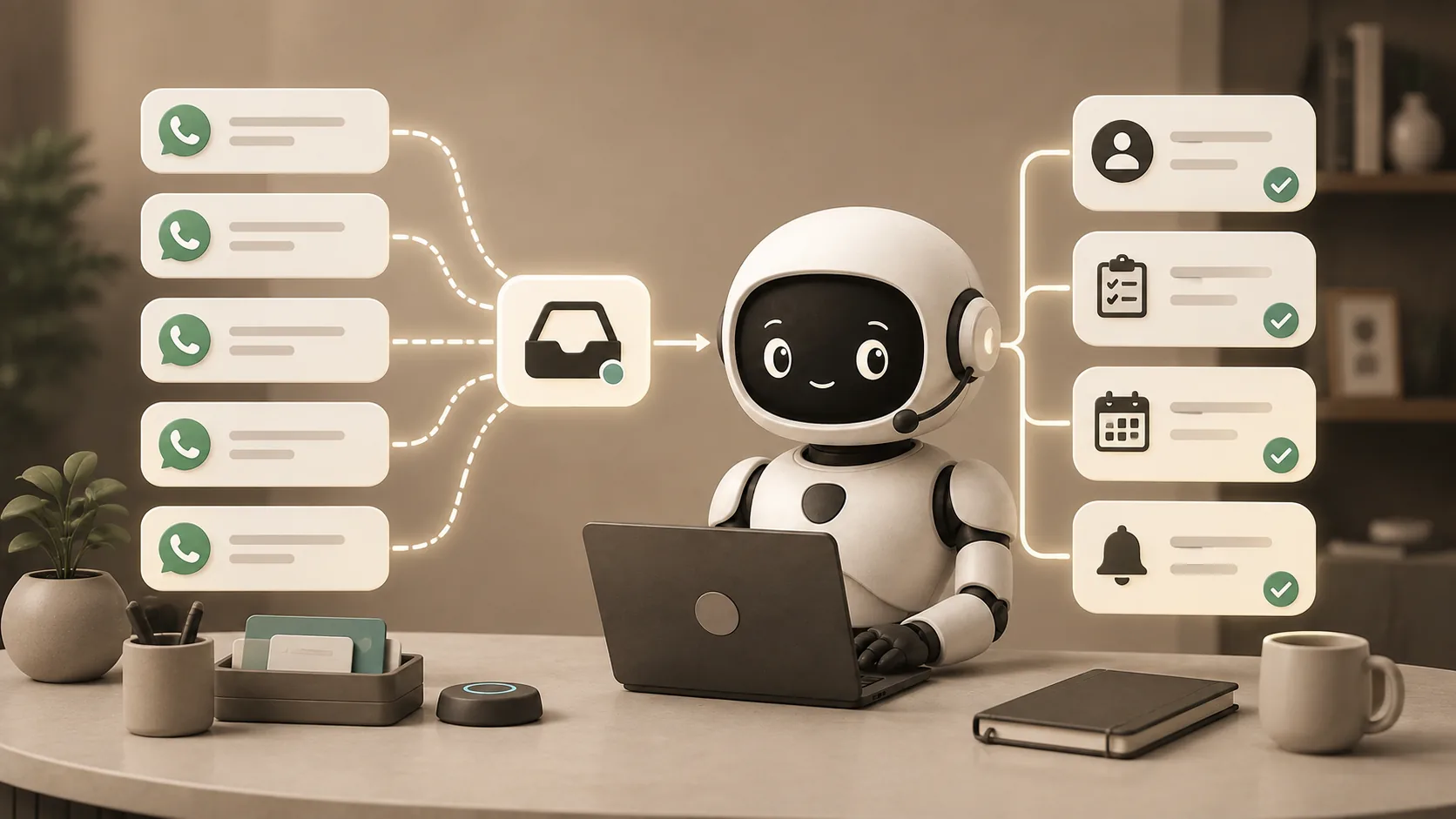
The system should be able to:
- capture the incoming message into a customer or lead record;
- identify the enquiry type;
- assign or route the conversation;
- keep the thread visible with context;
- trigger the correct next action;
- record the result in the pipeline or lifecycle.
That lets the business run real process around the channel it already depends on.
How this helps different service businesses
Clinics
A clinic can use WhatsApp to capture appointment enquiries, branch preference, and callback needs. The CRM then tracks whether the patient was booked, transferred, or lost. Staff no longer need to search old chats to understand context.
Salons and spas
A salon can handle booking requests, service questions, stylist preference, and reminder follow-up. The CRM makes repeat-booking and reactivation easier because customer history is no longer trapped in personal chats.
Schools
A school can turn admission enquiries into structured records with class interest, campus preference, parent details, and counsellor assignment. The same WhatsApp thread can stay visible while the CRM tracks follow-up discipline.
Restaurants
A restaurant can capture reservations, event enquiries, and order-related conversations in one place instead of switching between WhatsApp, notes, and manual callbacks.
Agencies and local service providers
An agency or local service team can use WhatsApp to capture scope, urgency, and qualification details, then convert the conversation into a trackable opportunity instead of leaving it in chat history.
Why WhatsApp-first is especially practical in India
In many Indian businesses, the sales or service workflow already starts on messaging. Teams often manage leads while moving between calls, counters, floor work, field visits, and operations. A WhatsApp-first CRM supports that reality instead of forcing desktop-first behaviour.
It also helps bridge the gap between marketing and operations. An Instagram ad, website form, Google Business Profile click, or referral often ends in a WhatsApp conversation anyway. When that conversation is connected to CRM properly, the business gets one clearer path from enquiry to action.
Where automation fits in
WhatsApp-first does not mean every message should be automated. It means automation should work around the WhatsApp conversation when it is useful.
Good uses include:
- instant acknowledgement;
- qualification questions;
- booking or callback capture;
- reminders for incomplete follow-up;
- shared inbox routing;
- escalation to staff with summary context.
Bad uses include:
- inventing unavailable offers;
- continuing through confusion or complaint;
- sending excessive follow-up without stop conditions;
- bypassing human review for sensitive or uncertain cases.
The best result is not a chatbot for its own sake. It is faster response with better team visibility.
What to connect first
If you are moving toward a WhatsApp-first CRM, do not begin with every department. Start with one business-critical workflow.
Good first examples include:
- clinic appointment enquiries;
- salon booking and repeat reminder flow;
- school admission lead capture;
- restaurant reservations;
- agency discovery enquiry qualification.
Connect just enough to prove the operating model:
- WhatsApp message enters the CRM.
- Lead or customer record is created or matched.
- One owner or queue is assigned.
- One next step is triggered.
- One outcome is measured.
Once that works reliably, expand to more services or more channels.
What should be measured
If WhatsApp is your real customer front door, then CRM metrics should reflect it.
Track:
- time to first reply;
- leads created from WhatsApp;
- booking or consultation conversion;
- staff handoff rate;
- follow-up completion rate;
- unresolved conversations;
- response quality by branch or owner.
This is where the value becomes obvious. You move from “we get a lot of messages” to “we know which conversations turn into business.”
What about consent and broadcast messages?
A WhatsApp-first CRM for service conversations is not the same as mass promotional messaging. Customer service notifications, approved templates, opt-ins, and outbound marketing each need clear rules.
Meta’s official WhatsApp Cloud API documentation explains the supported messaging workflow. In India, businesses should also review the current TRAI customer preference framework and confirm how their actual use case is handled operationally and legally. This is practical guidance, not legal advice.
FAQ
Is WhatsApp-first CRM only for very small businesses?
No. It is often most useful for growing businesses that already receive a high share of enquiries on WhatsApp and need more visibility and discipline.
Does this replace email and phone?
No. It means WhatsApp is treated as a primary intake channel, not that all other channels disappear. The CRM should still unify calls, forms, and other sources.
Can multiple team members work from the same WhatsApp conversation?
Yes, that is one of the biggest benefits of a proper shared inbox plus CRM model. The conversation becomes team-visible instead of device-bound.
What is the best first result to aim for?
A customer message should reliably become a visible record, an assigned owner, and a next action without depending on one person remembering to do it manually.
Final takeaway
If your team already depends on WhatsApp to win and serve customers, then WhatsApp should not sit outside your operating system.
A WhatsApp-first CRM helps Indian service businesses respond faster, reduce dropped leads, and keep customer context visible from first message to final outcome.
If you want to see how that would work for your business, explore our WhatsApp automation service, AI chatbot and CRM automation service, or contact Trootlabs.