Published 26 August 2026 · 8 min read
How AI + CRM Helps Small Businesses Follow Up Faster in India
Trootlabs Editorial Team
AI automation practitioners serving businesses across India
Last updated 26 August 2026
Key takeaways
A fast skim of the article, formatted so it is easy to read, share, and reuse in AI tools.
- AI plus CRM works best when the CRM stays the source of truth and AI handles fast first responses, qualification, reminders, and routing.
- Small businesses usually lose leads because follow-up is delayed or inconsistent, not because staff do not care.
- The strongest first rollout starts with one enquiry type, one channel, and one measurable next step like a booking or callback.
Most small businesses do not lose enquiries because people stop caring. They lose them because follow-up is delayed, fragmented, or forgotten while staff handle calls, walk-ins, bookings, billing, and operations.
AI and CRM work best together when they solve that exact problem. The CRM becomes the system of record for every enquiry, customer, and next step. AI handles the repetitive follow-up tasks around that record: quick first response, qualification questions, reminders, summaries, and handoff preparation.
The result is not “fully automated sales.” It is faster, cleaner response with better visibility.
Why follow-up slows down in small businesses
The pattern is similar across clinics, salons, schools, restaurants, agencies, and local service businesses.
A prospect sends a WhatsApp message, fills a website form, calls after hours, or asks a question on Instagram. Someone intends to reply later. Then the day gets busy. By the time the team responds, the customer has already moved on.
The common bottlenecks are:
- enquiries arriving across too many channels;
- no single place to see who needs a reply;
- weak qualification before handoff;
- no reminder or stop-condition logic;
- staff following up from memory instead of process.
A CRM fixes the visibility problem. AI helps with the speed and consistency problem.
What AI should do in a follow-up workflow
A useful AI follow-up layer is narrow and controlled. It should not invent discounts, promise unavailable slots, or push customers endlessly. It should complete specific tasks around a real pipeline.
Typical safe tasks include:
- Instant first response to a new enquiry.
- Approved qualification such as service type, timing, location, budget range, or class of need.
- Lead summarisation for a human owner or salesperson.
- Reminder follow-up when a prospect has not replied.
- Routing to the correct staff member, branch, or queue.
- Stop conditions when the customer converts, declines, opts out, or asks for a person.
This is especially useful when customers expect a response within minutes, not hours.
What the CRM must still own
The CRM is not optional in this setup. Without it, the business gets faster messages but not better operations.
The CRM should remain the source of truth for:
- lead and customer records;
- contact history;
- stage or status;
- assigned owner;
- next action;
- booking, quote, or invoice context;
- reporting on outcomes.
AI should read from and write to that structure, not replace it with a loose chat history.
How this helps different Indian SMBs
The benefit is the same, but the workflow differs by business type.
Clinics
A clinic can use AI to capture appointment intent, clinic location, preferred day, and non-clinical questions before routing the patient to staff or a booking workflow. The CRM keeps the patient enquiry, callback owner, and appointment outcome visible.
Salons and spas
A salon can respond quickly to service questions, stylist availability, and booking requests, then remind customers about incomplete bookings or repeat appointments. The CRM keeps the service history and repeat-business opportunities organised.
Schools
A school can capture admission enquiries, class interest, location, and callback preference, then pass a clean summary to counsellors. Instead of scattered WhatsApp threads, the CRM shows which families were contacted and what comes next.
Restaurants
A restaurant can separate table-booking enquiries, event requests, and order-related questions. AI can handle the early sorting and confirmations while the CRM keeps repeat-customer details and follow-up lists for offers or event leads.
Agencies and local service businesses
An agency, repair business, or home-service team can use AI to capture service type, urgency, budget range, and site location, then route high-intent leads to the right owner with context already attached.
The best first workflow to automate
Do not automate everything at once. Pick one enquiry type that already happens often and already has a clear next action.
Examples:
- a clinic’s appointment enquiry;
- a salon’s booking request;
- a school’s admission callback;
- a restaurant’s reservation or catering enquiry;
- an agency’s project discovery enquiry.
A practical rollout looks like this:
- Pick one channel first. Usually WhatsApp, website forms, or after-hours calls.
- Define approved questions. Ask only what staff genuinely need.
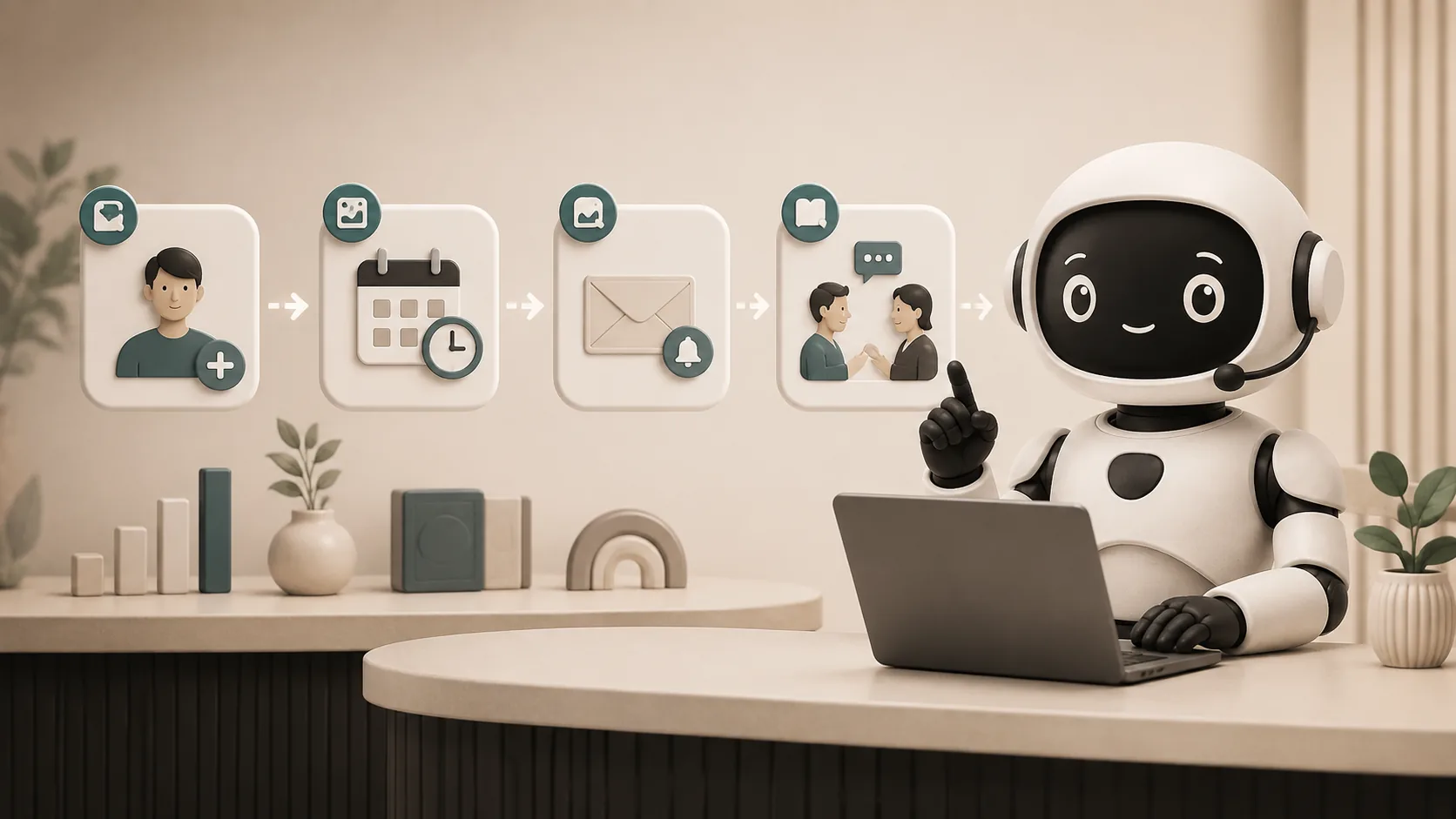
- Map one CRM stage flow. New enquiry → qualified → owner assigned → booked or closed.
- Add one follow-up rule. For example, a reminder after 30 minutes or next morning.
- Add one human handoff rule. High intent, unclear need, special request, or complaint.
That gives the team something measurable instead of a vague automation promise.
Why speed matters more than script cleverness
Many businesses over-focus on making AI sound impressive. In practice, customers care more about getting a useful next step quickly.
A plain but accurate follow-up that confirms service availability, asks the right qualification question, and routes to the correct person is better than a clever assistant that guesses, delays, or confuses the next step.
That is why the combination matters:
- AI gives speed, consistency, and controlled repetition.
- CRM gives memory, ownership, and pipeline visibility.
Together they reduce the gap between first enquiry and real action.
What should never be automated blindly
There are clear boundaries.
Avoid fully automated handling for:
- disputes or complaints;
- sensitive financial negotiation;
- clinical or legal judgement;
- unusual custom requirements;
- anything uncertain enough that staff would want context before replying.
The right approach is not “AI or human.” It is “AI until the point where human judgement matters.”
What to measure after launch
Track outcomes, not message count.
Useful measures include:
- time to first response;
- qualified enquiries created;
- handoff rate;
- booked appointments or consultations;
- reply rate after reminder follow-up;
- leads lost after no response;
- conversion by source and owner.
If response time drops but bookings do not improve, the workflow needs better qualification or better handoff. If bookings improve but staff still feel overwhelmed, the CRM stages or assignment rules may need work.
FAQ
Does AI replace my sales or front-desk staff?
No. It reduces delay and repetitive work. Staff still handle judgment, exceptions, negotiation, and sensitive conversations.
Is AI + CRM only useful for large teams?
No. Small teams often benefit more because missed follow-up hurts them faster and they usually work across multiple channels at once.
Should I start with WhatsApp or website leads?
Start where the business already gets the most real enquiries. For many Indian SMBs, that is WhatsApp. For others, it is forms or after-hours calls.
What is the best first result to aim for?
A faster first response plus one clean next step: booking, callback, site visit, quote request, or owner assignment.
Final takeaway
If your business already gets enquiries but follow-up depends too much on memory, speed, or one over-busy person, AI plus CRM is worth serious attention.
The best implementation does not feel like “more software.” It feels like fewer missed leads, cleaner handoff, and faster action.
If you want to see how that would work for your clinic, salon, school, restaurant, agency, or service business, contact Trootlabs or review the AI chatbot and CRM automation service.